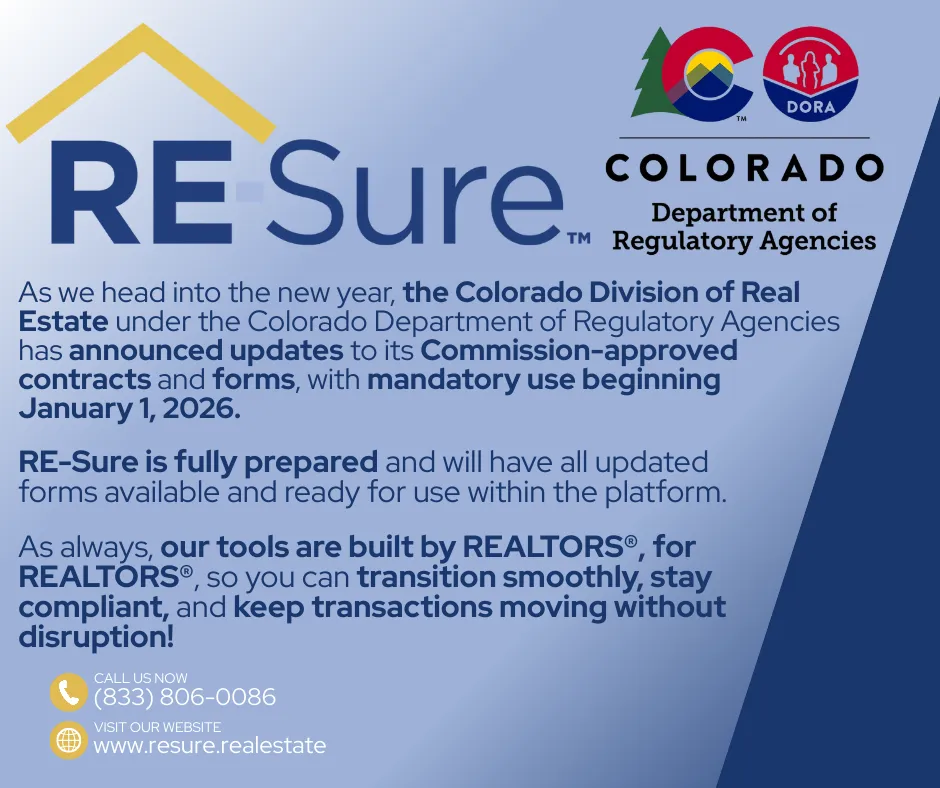
DORA Forms Update 2026
Colorado DORA Real Estate Forms:
What’s New in 2026
As of January 1, 2026, the Colorado Real Estate Commission has implemented one of the most significant updates to Commission-approved contracts and forms in recent years. These changes reflect ongoing efforts by the Department of Regulatory Agencies (DORA) and the Division of Real Estate to modernize transaction paperwork, ensure compliance with current legal standards, and improve clarity for brokers, clients, and stakeholders involved in real estate transactions. Whether you’re a seasoned broker or a new licensee, being up-to-date with these revisions isn’t optional, it’s mandatory for every transaction conducted in Colorado starting in 2026.
Good news is, RE-Sure already maintains and updates all Commission-approved forms within the platform, any drafted or in-progress contracts automatically reflect the 2026 DORA changes, eliminating manual replacements, version errors, or last-minute compliance issues for brokers.
Summary of the 2026 Form Revisions
The new forms package includes updates to 21 existing documents and the introduction of 2 new forms, all of which carry a mandatory use date of January 1, 2026. These forms must be used in place of any prior versions; older PDFs and templates should be retired from practice.
The updated library is available through the Division of Real Estate’s Contracts and Forms webpage in both “clean” and “redlined” formats for comparison and education.
Key Categories of Updated Forms
The 2026 revisions span multiple sections of typical real estate paperwork:
Listing Contracts – Exclusive right to sell, buy, lease, and tenant listing contracts have been redefined for clarity on brokerage obligations and compensation structures.
Sales and Purchase Agreements – Residential, commercial, income-property, land, and specialized contracts such as the Colorado Foreclosure Protection Act versions have been updated to reflect current practices and legal expectations.
Addenda and Disclosures – Residential and commercial property disclosures have been revised. Multiple addenda (e.g., water source, manufactured home, short sale) are updated to align with the Code’s requirements.
Objection and Notice Forms – Inspection objection and resolution notices have been adjusted to give clearer structure around buyer rights and timing.
Closing and Post-Closing Documents – Closing instructions, closing statements, and related paperwork are now aligned with updated closing procedures and obligations.
Optional and Specialty Forms – Items such as post-closing occupancy agreements and manufactured home extensions are newly updated or introduced to address specific transaction needs.
Notable New Forms
The Commission has added two new forms for 2026 that practitioners should be aware of:
Agreement to Revive Contract – Manufactured Home – Offers a standard process to reinstate a previously expired manufactured home contract.
Manufactured Home Extension or Termination – Creates a structured choice for parties dealing with these unique property types.
Important Structural Changes Brokers Should Note
Some of the more substantive revisions in the updated forms focus on clarifying rights, responsibilities, and timing:
Assignability Clauses in the Contract to Buy and Sell now more explicitly outline whether and how a buyer may assign their rights under the agreement.
Deadlines and Timing Rules are standardized across forms, with clearer guidance on how to handle weekend and holiday cutoffs for critical performance dates.
Earnest Money Provisions have been clarified to define timing and release mechanisms with greater specificity, reducing ambiguity in closing scenarios.
These kinds of structural improvements are aimed at reducing disputes and litigation risk, as well as guiding brokers more precisely through transactional milestones.
Education and Compliance Expectations
DORA and the Division of Real Estate have emphasized stakeholder awareness and preparation. Updated forms have been published in educational formats throughout 2025 and continuing into early 2026, including free online courses available to brokers.
Continuing education providers are also offering CE classes specifically focused on these 2026 contract and form changes to help licensees remain compliant and competent.
Conclusion
The 2026 DORA form updates represent a comprehensive overhaul of Colorado’s real estate forms framework. The emphasis on clarity, legal alignment, and procedural precision reflects ongoing regulatory refinement designed to support both brokers and consumers. Practitioners who proactively adopt these updates and invest time in understanding their implications will strengthen compliance, reduce risk exposure, and facilitate smoother transaction outcomes throughout the year.
As Colorado transitions into the 2026 DORA form requirements, RE-Sure users do not need to take additional action to remain compliant. All Commission-approved form updates are already live within the platform, including updates to previously drafted and in-progress contracts. This ensures brokers are always working with the correct, current versions without manual uploads, re-drafting, or risk of using outdated documents, allowing transactions to continue smoothly while maintaining full regulatory compliance.
